Unlock HYROX: Your Beginner's Training Playbook

Ever heard of a fitness challenge that’s absolutely exploding in popularity, drawing in everyone from gym newbies to elite athletes? You probably have, and it’s called HYROX. Since its debut in 2017, this innovative fitness race has truly captivated the world. What I've found is its unique blend of strength and endurance makes it incredibly addictive. The 2025 World Championships marked its sixth iteration, with events now spanning five continents and attracting over half a million participants in major cities like London, Chicago, and Cape Town. Pretty impressive, right?
HYROX is intense, yes, but surprisingly beginner-friendly. It’s truly open to athletes of all stripes, making it an ideal fitness gauge whether you’re easing back into exercise or hunting for a fresh, demanding challenge. From breaking down each grueling station to sharing pro-level training hacks, this guide is your go-to resource for conquering your very first HYROX race. Let’s dive in!
What is HYROX training?
Simply put, HYROX training means getting your body ready for a HYROX race. This usually involves practicing the eight distinct stations you’ll encounter (more on those beasts shortly). Given the sport's meteoric rise, you might find yourself learning the ropes at an affiliated gym, soaking up tips from elite athletes online, or even investing in a personal coach. The options are plentiful, and honestly, I think finding a community makes all the difference.

Here's the thing about HYROX: no matter where you compete globally or what your fitness level, every single race uses the exact same exercises in the exact same sequence. And what truly surprises most people is that there’s no strict time limit. This means it’s as much about smashing your personal bests as it is about outpacing your rivals. (Though, let’s be real, a new PB and a podium spot? That’s the dream!)
Jake Dearden, a HYROX World Champion and Elite 15 athlete who crushed a new PB of 55 minutes and 44 seconds at HYROX Glasgow in 2025, explains it best. "The level of entry is really low," he says. "The movements don't require a massive amount of skill compared to other sports. Anyone can enter; whether it's the average gym-goer or a committed HYROX athlete." That’s a powerful statement from an expert, isn't it?

You'll find two main competition categories: Pro and Open. While the Pro division is geared towards those with a higher baseline of fitness, the Open category is a fantastic starting point for almost anyone. Whatever your current ability, you're guaranteed to be competing alongside others who share a similar fitness level. This means you can progress through the HYROX ranks together, which is pretty motivating!
HYROX core training elements
HYROX is meticulously designed to push your strength, endurance, and overall fitness to their limits. Sound a bit overwhelming? Don't sweat it. When we talk about "training elements," we're really just outlining the types of fitness you'll want to cultivate before your debut race.

Interestingly, industry experts often label HYROX a "hybrid" sport. What does that mean? Basically, instead of just focusing on running or solely on strength, HYROX demands equal proficiency in both. This balance makes it genuinely engaging, adding fantastic variety to your workouts because you don’t need to specialize in just one area. "In hybrid training, the focus is on improving strength and fitness in a perfect balance," Dearden confirms.
To really grasp the training philosophy, let's look at the science. Recent scientific studies (Brandt et al. (2025) and Davids (2025)) have painted HYROX as an interval-based endurance sport. The key takeaway here is that a higher volume of endurance training directly correlates with faster finish times.

In essence, you need to be functionally fit for a wide array of tasks. Tiago Lousa, a HYROX master coach, elaborates: "In HYROX, the variability of the tasks makes durability even more obvious and even more decisive. The sport constantly tests your ability to perform under accumulated fatigue, and that is why durability plays such a central role."
Beyond just raw fitness, both studies underscored that pacing is just as critical. The ability to maintain solid technique even when fatigue sets in is absolutely vital for a strong performance. Lucy Procter, a rising British star who clinched fifth place in the Elite Women's race at the 2025 World Championships in Chicago, wholeheartedly agrees. "Pacing wisely is one of the most important things for a first-time HYROX athlete," she advises.

When you're new to any sport, that starting gun can make you want to go all out. Procter strongly cautions against this. "When beginners ask for my top three tips, my number one is always: don’t go out too hard. It’s so tempting to push right from the start, but the best thing you can do is keep the SkiErg at an easy pace," she reveals. Trust me, listening to the pros on this one is smart.
So, to sum it up, a HYROX race challenges you across eight different workouts. But, what I've observed is that building your capacity to transition smoothly between these diverse exercises, without rushing or losing your rhythm, could truly be the game-changer.

The eight HYROX exercise stations and their demands
As we’ve discussed, the race features eight distinct workouts. But here’s the kicker: you'll also complete eight 1-kilometer runs, with one run preceding each station. That's a lot of running, folks!
1,000m SkiErg
You’ll grab the handles of the Concept2 SkiErg machine and pull them downwards, mimicking the powerful motion of cross-country skiing. It’s a steady, controlled movement, but yes, it’s incredibly demanding if you don't manage your effort. Remember Procter's advice: take it slow here to avoid burning out before the race truly begins. This initial station sets the tone, so don't sprint out of the gate.

50m Sled Push
Just as the name implies, you'll be pushing a weighted sled across 50 meters. This is a full-body effort, but your powerful thighs will do most of the work. Your core needs to stay rock-solid, keeping your torso and arms locked in position. What I’ve found is that short, strategic pauses during the sled push can offer your legs a much-needed micro-rest before you launch into the next run.
50m Sled Pull
After another run, you’re now dragging the sled in the opposite direction. Here, you'll hoist the sled towards you using a rope. Your arms and back are crucial, but you do have some room to step backward as you pull, allowing your legs to contribute. Just be careful not to trip over that rope – it happens!
80m Burpee Broad Jumps
Eighty meters of burpee broad jumps. Sound like hell? Honestly, it might feel like it this far into your race. But you’ve got this! This station combines two brutal movements – burpees and broad jumps – challenging both your cardiovascular endurance and your leg explosiveness. It’s a true test of grit.
1,000m Row
After your fifth run, you finally get to sit down... to row! You'll complete 1 kilometer on the Concept2 rowing machine. This is a massive cardio workout that also puts your stamina to the test. While going all out here might shave off a few precious seconds, you absolutely need to conserve energy. With three stations still ahead, pacing remains paramount.

200m Farmer's Carry
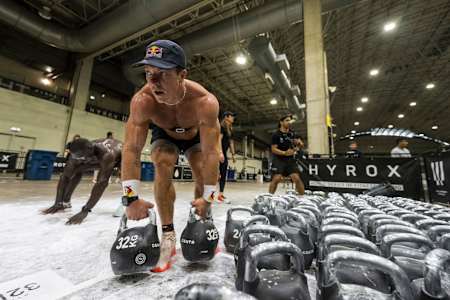
Participants grab two heavy kettlebells and walk-run as swiftly as possible for 200 meters. The good news? You can stop and put the bells down whenever you need a break. The bad news? Speed is still the objective. From what I’ve observed, imagining ice packs waiting for your protesting shoulders post-race can be a surprisingly effective motivator!
100m Sandbag Lunges
By this point, your legs will likely be screaming, making this a particularly challenging station. The sandbag's weight varies based on your HYROX category, but one rule is constant: your knees must touch the floor with every single lunge. And here’s the kicker: you can't put the sandbag down until you've completed the entire station.
100 Wall Balls
The grand finale! This last station demands both accuracy and sheer endurance. Competitors squat down with a medicine ball, then explode upwards, throwing the ball to hit a designated target. You'll do this for a total of 100 repetitions. After catching the ball, you immediately repeat the motion. The target height and ball weight differ by gender and division. Maintaining proper form here is not just about efficiency; it's about not wasting precious energy.
How to train for HYROX
The most effective way to prepare for HYROX, generally speaking, is to join a dedicated class or hire an experienced coach. This personalized approach truly helps you discover a training method that clicks for you. Here's why this matters: there's no magic, one-size-fits-all program. Even among the elite athletes, training routines vary wildly. For instance, multiple-time HYROX World Champion Alexander Rončević dedicates "20 to 25 hours a week, twice a day, with intervals, long runs, strength, and technique." On the flip side, Dearden focuses on "two days of strength work, two days’ running work, focusing on speed and speed endurance. Then, I do one big conditioning session, building up that ability to move on fatigued legs."
Of course, these top HYROX athletes have honed their training over years of intense experience. If you’re just starting out, you won't be at that level yet. And let's be honest, as a beginner, you probably don't have the time to train like a professional athlete!
One thing is absolutely certain: cardiovascular work needs to be a significant part of your training plan, just as it is for Procter. "Running makes up about 40-50 percent of my weekly training hours," she shares. That said, this doesn’t all have to be running, especially if you're dealing with nagging knee pain or issues like shin splints. "Since HYROX is an endurance sport, aerobic training is key, but too much running can lead to fatigue or injury," Procter explains. "There’s a point where the returns diminish, so instead of overloading on miles, I balance it with other aerobic activities like cycling."
However you choose to train, maintaining excellent nutrition – and proper fueling – is non-negotiable. Robinson Bentler, a sports scientist and hybrid coach, emphasizes: "HYROX is a high-intensity race and you will be burning carbs at a very high rate." Bentler advises that your fueling strategy should actually kick off 24 hours before your race. "Focus on eating a lot of carbs while cutting out fats and protein to ease up your digestion," he suggests.
Finally, and this is crucial, one of the most vital aspects of HYROX training is… your mind. Even if it’s your very first race, battling through eight stations and eight runs can be as much a mental marathon as a physical one. Dearden offers a powerful final tip: "When I’m in a dark place in competition, I think about all the people watching, all the people that have made the journey to come to support me," he says. "You won’t let them down." That kind of mental fortitude is priceless.
So, there you have it. HYROX is a dynamic, hybrid fitness challenge that demands a balanced approach to training. Pacing yourself, understanding the unique demands of each station, and crucially, preparing your mind are all key ingredients for success. Whether you're aiming for a new personal best or simply want to finish strong, embracing these principles will set you up for an unforgettable race experience. Go find your first competition – you’ve got this!
Get your dream items with discounts up to 80%
Post a Comment